

How to Choose Open-Ear Earbuds in 2026: Ignore the Bass Claims, Watch Fit, Leakage, and Where They Fail
Open-ear earbuds — the clip-on and ear-hook buds that sit outside your ear canal instead of plugging it — have become one of the fastest-growing audio categories of the year, and for good reason: once you've spent a day wearing something that never blocks your ears, sealed buds can start to feel like earplugs. The pitch leans on two promises: all-day comfort and, increasingly, "premium sound" with "powerful, rich bass" that supposedly rivals what's in your ears. The comfort is real. The sound claims are where the marketing outruns the physics, and where it's easy to buy a pair expecting one thing and getting another — thin bass, audio your seatmate can hear, or a fit that works great on the couch and slips on a run.
Here is exactly what matters when choosing open-ear earbuds, and what is just marketing noise.
The short answer
If you want to skip the deep dive, here is the baseline of what to look for in a modern pair of open-ear earbuds:
- The bass compromise is physics, not a spec: Check your expectations first. Because nothing seals your ear canal, low frequencies escape — bass will always be lighter than sealed buds, and no EQ fully fixes it. Buy open-ear for comfort and awareness, not for deep bass.
- Fit and security decide everything: A bud you have to keep re-seating tracks nothing but your frustration. Clip and hook designs that spread weight across the ear stay put; a bad fit slips on a jog or aches after an hour.
- They leak — most in quiet rooms: At moderate volume in normal places, leakage is minimal. In a library, a silent office, or a quiet train, people near you can hear it — and it gets worse the louder you go.
- They can't beat noise: In loud places you'll crank the volume (leaking more) and still lose. For pure isolation on a commute or busy gym, sealed buds still win.
Before we break down what to look for, here's why the open design sounds the way it does — and why the thing that makes these buds so comfortable is the same thing that costs you bass:
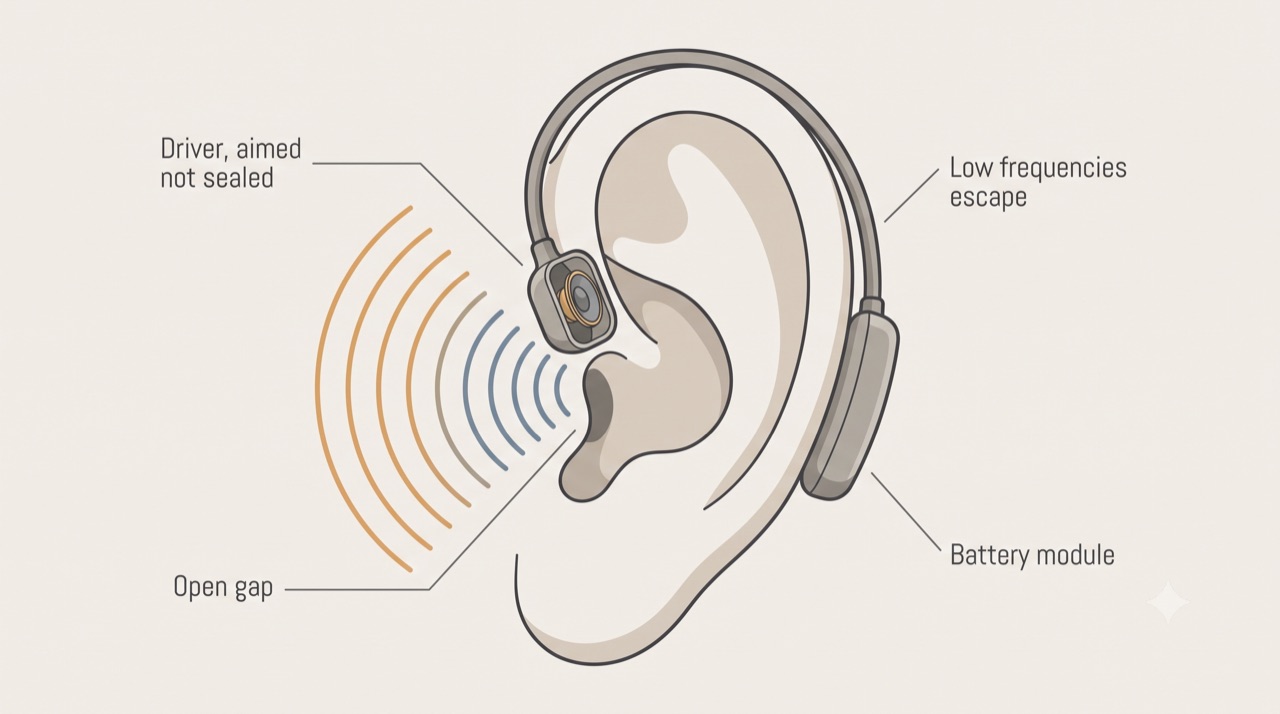
The bass compromise is physics, not a tuning problem
This is the claim to be most skeptical of, because it's the one the marketing works hardest to paper over.
Sealed in-ear buds sound bassy because they trap and pressurize low frequencies inside your ear canal. Open-ear buds deliberately don't seal anything, so those same low frequencies escape into the air instead of building up against your eardrum. The result is baked in: bass sounds thinner and less physical than with in-ear or over-ear headphones, and while EQ presets and companion apps can nudge it, you can't fully EQ your way out of the physics.
The better models genuinely narrow the gap. Well-engineered designs use directed drivers and clever tuning to push more midrange and low-end at your ear than the open geometry should allow, and at sensible indoor volume the top pairs sound warm and pleasant, with vocals sitting forward. But "surprisingly good bass for an open-ear bud" is not the same as "good bass," and a listing that leads with "powerful bass" is selling you the exception as the rule. If a big, punchy low end is what you care about, this is the wrong category — buy open-ear for comfort and awareness, and judge the sound by whether long-term owners are happy, not by the adjectives on the box.
Fit and security are the whole experience
An open-ear bud's entire value depends on one thing: you keeping it comfortably in place. Get this wrong and nothing else matters.
Because these buds hang on or clip to your outer ear rather than wedging into the canal, the mechanical design does all the work, and it varies enormously. Clip-on styles that pinch the rim of your ear and spread their weight along the cartilage tend to disappear on your head and survive a workday without the pressure-headache some hooks cause. Ear-hook styles loop over the top of your ear and can be more secure for hard movement but bulkier and awkward with glasses. The failure modes are real: a bud that fits your ear shape well is invisible; one that doesn't either aches after an hour or works loose and slips during a run or a workout. Ear shape is individual, so the pair a reviewer loves may not sit right on you — weight, clamping force, and how the design matches your ear matter more than the driver specs. Read what owners with active use report, and favor a secure, weight-distributed fit over a flashy sound claim.
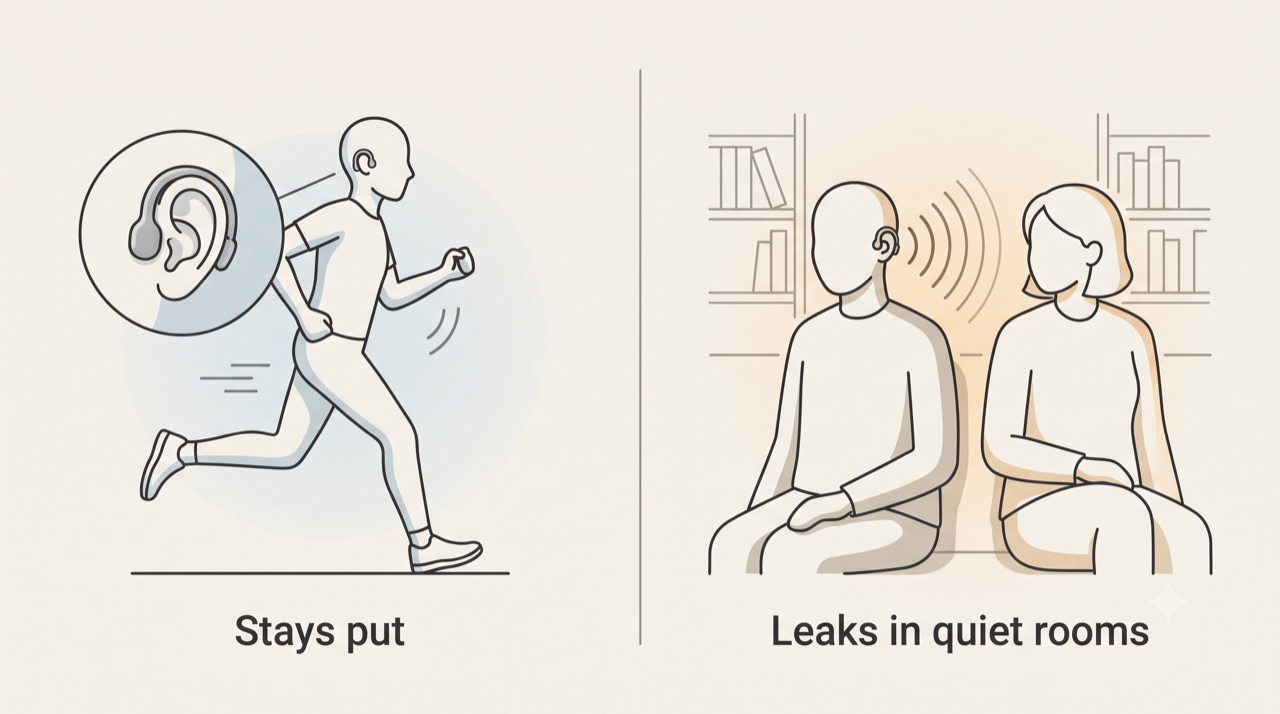
Sound leakage: fine on the street, a problem in a quiet room
Because open-ear buds don't seal anything, some of your audio inevitably escapes into the air — the same openness that lets you hear the world lets the world hear a little of your music. How much of a problem this is comes down almost entirely to volume and how quiet your surroundings are.
At moderate volume in a normal environment — a busy office, a street, a coffee shop — leakage is usually minimal and nobody notices. The trouble starts in genuinely quiet spaces: a library, a silent office, a quiet train carriage, where even low leakage becomes audible to someone sitting close, and the effect scales up sharply as you raise the volume. There's a nasty feedback loop here, too: open-ear buds tempt you to turn the volume up to overcome background noise or wind, which is precisely the moment they leak the most and disturb the most people. If you'll be using them somewhere quiet, or taking calls with others around, test the leakage at the volume you actually listen at — not a polite demo level — before you count on them for privacy.
Where open-ear simply can't compete
Every honest open-ear recommendation comes with a boundary: these are awareness devices, not isolation devices, and buying them for the wrong job guarantees disappointment.
Because nothing blocks your ear canal, open-ear buds can't shut out ambient noise — and that's not a flaw to fix, it's the entire point. On a loud commute, a plane, or a clattering gym floor, they can't compete with the background, so you crank the volume (leaking more) and still lose the battle. Wind is a specific weakness: cycling or running in a breeze, you'll push the volume to maximum to hear over it, which spikes leakage and still doesn't fully win. And sweat resistance varies, so if you're buying for exercise, check the IP rating rather than assuming. The flip side is genuine: for outdoor running and walking where hearing traffic is a safety feature, for long workdays where comfort and staying reachable matter, open-ear is often the better choice. Match the buds to where you'll actually use them — for pure noise-blocking on a commute or heavy training, a sealed pair still wins, and no amount of open-ear tuning changes that.
When you buy open-ear earbuds, you're trading sealed-in bass and noise isolation for all-day comfort and awareness — a trade that's excellent for some lives and wrong for others. The launch-day demo, played at a polite volume in a quiet studio, can't tell you whether the bass satisfies you on your commute, whether the clip stays put on a run, or whether your seatmate can hear your podcast — but the people wearing them every day can.
The bass compromise, real-world fit and security, and how much they leak in a quiet room don't show up in a product photo. Use Avorio to aggregate real long-term owner reviews, check Reddit sentiment, and find the best live price on the open-ear buds that actually suit how you'll use them →
Don't rely on static reviews to make the final call. Avorio aggregates thousands of real user reviews, filters out sponsored and AI-generated content, scores real-world sound, fit, leakage, and comfort across Reddit, YouTube, and social media, and finds the lowest live price.
Search open-ear earbuds on Avorio →
Frequently asked questions
Do open-ear earbuds have good bass?
They have more than you'd expect from the design, and far less than a sealed in-ear bud. Because open-ear buds don't seal your ear canal, low frequencies escape rather than being trapped and pressurized against your eardrum, so bass will always sound thinner than with in-ear or over-ear headphones. Good models use clever tuning and directed drivers to push more low-end at you than the geometry should allow, and at moderate indoor volume the better ones sound genuinely pleasant. But no EQ setting fully fixes the physics — if deep, punchy bass is your priority, open-ear is the wrong category. Buy them for comfort and awareness, not for the low end.
Can other people hear my music through open-ear earbuds?
Sometimes, and it depends almost entirely on volume and how quiet the room is. At moderate volume in a normal environment — an office, a busy street — leakage is usually minimal and no one notices. But in a genuinely quiet space like a library, a silent office, or a quiet train, even low leakage becomes audible to someone sitting close, and the effect gets dramatically worse as you turn the volume up. The trap is that open-ear buds tempt you to raise the volume to overcome background or wind noise, which is exactly when they leak most. If you'll use them somewhere quiet or take calls near others, test the leakage at your real listening volume before you rely on them.
Are open-ear earbuds good for the gym or running?
They're good for outdoor running and walking, and a mixed bag for the gym. The open design lets you hear traffic and your surroundings, which is a real safety benefit outdoors, and the better clip and hook designs stay put through a jog. But because nothing seals your ear, they can't block the clatter of a busy gym, and you'll be tempted to crank the volume — increasing leakage — to hear over it. Sweat resistance also varies, so check the IP rating. For pure noise isolation during heavy training, sealed sports buds still win; for situational awareness on a run, open-ear is often the better, more comfortable choice.
Avorio cuts through sponsored content to surface authentic product reviews from Reddit, YouTube, and social media — and finds the best live prices. Search open-ear earbuds on Avorio →