

How to Choose an LED Face Mask in 2026: Ignore the LED Count, Check Wavelengths, Clearance, Fit, and the Real Black Friday Price
LED masks are on sale everywhere. Here's how to spot the real deals.
Prices this season run tenfold from the cheapest mask to the priciest. The discount matters less than what you're paying for.
LED face masks went from dermatologist offices to TikTok to almost every early Black Friday list this year. CurrentBody, Omnilux, Shark and dozens of brands you've never heard of are all cutting prices, and the range is huge: about $60 for a no-name mask on Amazon, and $400 to $600 for the clinic brands.
The listings mostly compete on how many LEDs a mask has and how many colors it can glow. Neither number tells you much. What matters is which wavelengths it uses, whether it's cleared for the problem you want to treat, how close it sits to your face, and whether you'll keep using it for the two or three months it takes to see a change.
The short answer
If you just want the checklist:
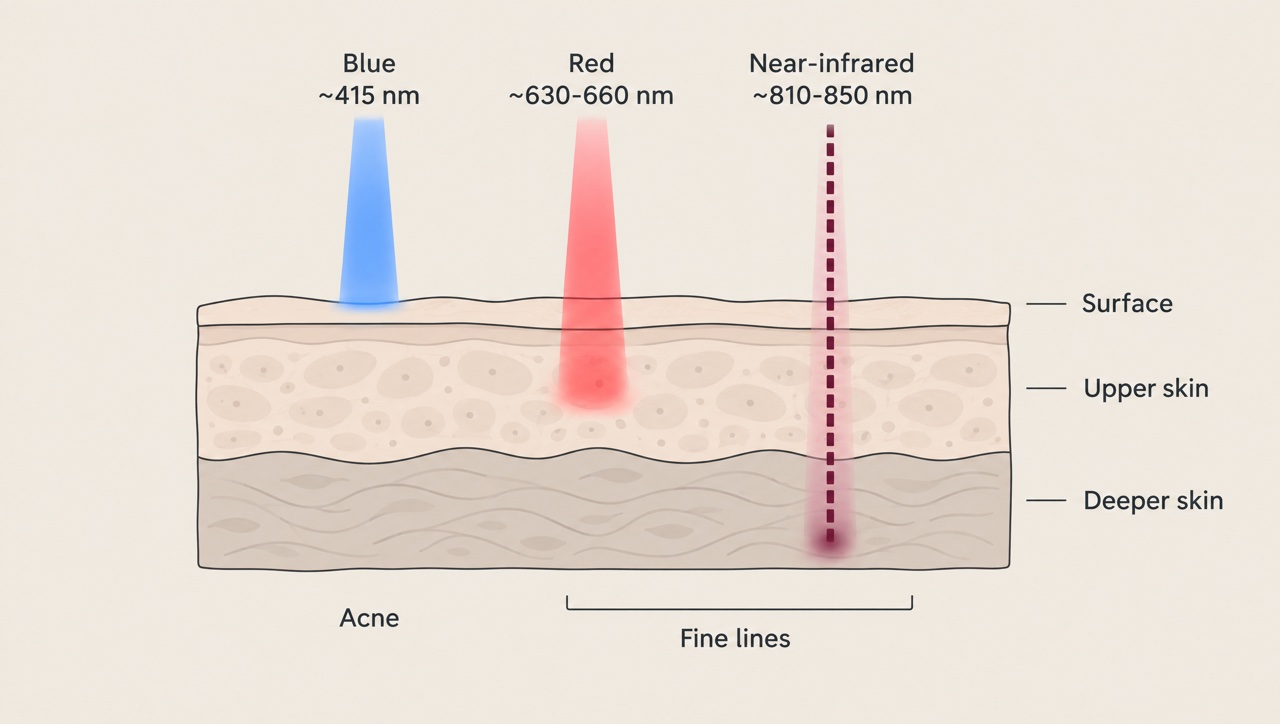
- Look for the wavelengths in nanometers. Red around 630 to 660 nm and near-infrared around 810 to 850 nm are the ones with research behind them for fine lines. Blue around 415 nm is for acne. A listing that says "7 colors" and gives no numbers is selling the light show.
- Check whether the mask is FDA-cleared, and for what. Clearance is for a specific use, so a mask cleared for acne isn't cleared for wrinkles. You can look it up in the FDA's 510(k) database.
- Ignore the LED count. How much light reaches your skin depends on output and distance, and only a few brands publish their output (irradiance, in mW/cm²).
- Check the price history before you trust the discount. Beauty devices often carry a "was" price they rarely sold at.
- Plan to use it about 10 minutes a session, several times a week, for at least eight weeks. If you won't, no mask is worth it.
Compare live prices and real owner reviews for top LED face masks on Avorio →
Start with the wavelengths
LED masks work by shining specific colors of light on the skin, and the color is set by the wavelength. Different wavelengths have been studied for different problems:
- Red light, at about 630 to 660 nm, reaches the upper layers of the skin. Small studies link it to modest improvements in fine lines and skin tone.
- Near-infrared, at about 810 to 850 nm, is invisible and goes a little deeper. Most of the better masks pair it with red, often at 633 and 830 nm, the combination Omnilux and CurrentBody use.
- Blue light, at about 415 nm, targets the bacteria involved in acne. It's the one to look for if breakouts are the main reason you're buying.
Amber, green, purple, cyan and the other colors on cheap masks have much less evidence behind them. Extra colors aren't harmful, but if a mask spends its listing on seven colors and never names a wavelength, you can't tell whether its red is the red that was studied.
What FDA clearance tells you
Many masks call themselves FDA-cleared. Clearance means the FDA accepted the maker's 510(k) submission showing the device is substantially equivalent to one already on the market, for a stated use. It's a lower bar than FDA approval, and it doesn't mean one cleared mask works better than another.
It's still worth checking. A cleared mask has been reviewed for its stated use and for basic safety, including eye safety, and the use is specific: "wrinkles," "mild to moderate acne," or both. Search the brand in the FDA's 510(k) database before you buy. If a listing says "FDA approved," or says it's cleared but you can't find the clearance, treat the claim as marketing.
Ignore the LED count and look at output and fit
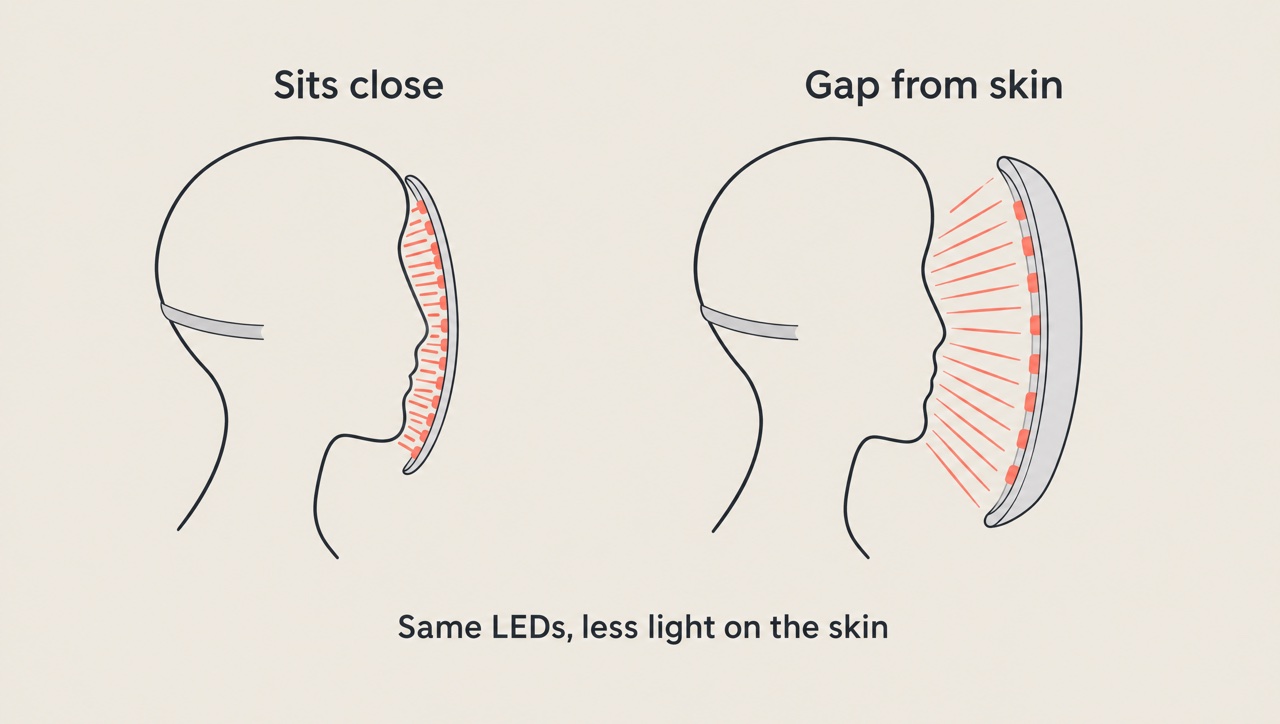
A mask with 200 LEDs isn't necessarily stronger than one with 100. The light that reaches your skin depends on how much each LED puts out and how far it sits from your face. Brands that publish this give it as irradiance, in milliwatts per square centimeter. Premium face masks tend to land around 30 mW/cm², and most cheap masks don't say at all.
Fit matters for the same reason. Light spreads as it travels, so a rigid mask that sits an inch off your cheeks delivers less to them than one that rests close. Flexible silicone masks follow the face better. Rigid shells are easier to clean and keep their shape. Whichever you choose, look for reviews that mention gaps around the nose, chin or forehead, and for owners with a face shape like yours.
A few other things owners mention:
- Cordless masks with a built-in timer are much easier to use daily than ones tethered to a wall outlet.
- Some masks add features beyond light. Shark's CryoGlow, for example, has cooling plates under the eyes.
- App-controlled masks work fine until the app stops getting updates, so read recent app reviews too.
- Neck and chest coverage usually costs extra, as a separate device.
Safety and who should skip one
LED masks are generally considered low risk, but the light is bright and close to your eyes. Use the eye shields or goggles if the mask comes with them, and don't stare into the LEDs. In 2019 Neutrogena recalled its Light Therapy Acne Mask over a possible risk of eye injury for some users, which is part of why eye safety is now one of the things a clearance review looks at.
Talk to a doctor first if you take a medication that makes you sensitive to light, such as isotretinoin or some antibiotics, if you have an eye condition, or if you have a condition that light can trigger, such as lupus. If you're getting treatment from a dermatologist, ask whether a mask fits with it.
Read the Black Friday price carefully
This is the time of year LED masks get their deepest cuts. Early sales this year include CurrentBody's masks at about 20% off, Omnilux at about $395 with a discount code, and INIA's 4D mask at $169.99. The no-name masks, which already cost $60 to $150, run "70% off" banners nearly all year.
Before you buy, check what the mask sold for over the past few months. A discount off a price nobody paid isn't a deal. Also check the return window. Results take weeks, so a return policy that only covers unopened boxes means you're committing before you can tell whether it works for you.
Deal or dud?
Things LED mask listings really say this time of year. Call each one before you peek.
WAS $899, NOW $79! 91% OFF, TODAY ONLY!!!
Red 633 nm and near-infrared 830 nm. FDA-cleared for wrinkles (K-number on the box).
7 colors! 192 LEDs! Galaxy rainbow mode!
FDA approved!
60-day returns, even if opened and used.
★★★★★ "Arrived fast, glows so pretty!!" (posted on day 2)
The best way to know whether a mask is worth its sale price is from people who used it for months. Marketing photos are taken under perfect lighting, and early reviews are written before anyone could have seen a change. People who've used a mask four times a week since spring can tell you whether their skin looks different and whether the mask still turns on.
Use Avorio to read long-term owner reviews, see what Reddit thinks, and find the best live Black Friday price on the LED mask that fits what you want to treat →
Avorio gathers thousands of real user reviews from Reddit, YouTube, and social media and filters out sponsored and AI-generated content. It scores results, comfort, and reliability, and finds the lowest live price.
Search LED face masks on Avorio →
Frequently asked questions
Do LED face masks actually work?
For some uses, modestly. Red and near-infrared light have small clinical studies behind them for fine lines, and blue light for mild acne. The results are gradual and smaller than in the marketing photos, and they only show up with regular use over several weeks. A mask won't replace a retinoid or a dermatologist, and it won't do anything for deep wrinkles or sagging skin.
What does FDA-cleared mean for an LED mask?
It means the FDA accepted the maker's 510(k) submission showing the mask is substantially equivalent to a device already on the market, for a specific stated use such as wrinkles or mild acne. It is clearance, not approval, and it doesn't rank masks against each other. It does tell you the mask was reviewed for that use and for basic safety, which most cheap listings were not. Check the FDA's 510(k) database for the brand and the use you care about.
Is a cheap LED face mask from Amazon worth it?
Sometimes, but you're buying blind. Most $60 to $150 masks don't publish their light output, so you can't tell how much light reaches your skin, and few are FDA-cleared. If the listing names its wavelengths, shows a clearance you can look up, and has reviews from people who used it for two months or more, it may be fine. If it sells on '7 colors' and a high LED count, skip it.
Avorio filters out sponsored content to show real product reviews from Reddit, YouTube, and social media, and finds the best live prices. Search LED face masks on Avorio →