
How to Choose an AI Voice Recorder in 2026: Ignore the 'AI Summaries,' Watch the Subscription and the Cloud
The wearable AI voice recorder went from niche gadget to one of the most-hyped categories of the year, with a wave of pin- and clip-sized devices promising to capture every meeting, lecture, and shower-thought and hand you back a tidy AI summary. The pitch is intoxicating: clip it on, talk, and let the AI transcribe, organize, and summarize your whole day. The listings sell that magic with the softest possible numbers — "AI-powered summaries," "smart notes," "unlimited transcription" — the features least likely to work the way you imagine once you're actually relying on them. It's easy to buy a cheap-looking recorder and discover the useful parts are locked behind a subscription, your audio is living on a company server, and you may be breaking a recording law you didn't know existed.
Here is exactly what matters when choosing an AI voice recorder, and what is just marketing noise.
The short answer
If you want to skip the deep dive, here is the baseline of what to look for in a modern AI voice recorder:
- The subscription is the real price: Check this first. The hardware often ships with a free tier capped at a few hundred transcription minutes a month; the genuinely useful volume lives behind a plan that can cost $100–$240 a year. A "cheap" recorder with a mandatory subscription can cost far more over three years than a pricier one without.
- Transcription minutes run out fast: That free ~300-minutes-a-month allowance is roughly five hours. A single day of meetings can blow through it, so read the cap, not the word "unlimited."
- Most transcription happens in the cloud: Your audio is usually uploaded to a company server, governed by their privacy and retention policy. If privacy matters, look for on-device transcription and read the fine print.
- The consent law is your problem, not the device's: Recording without permission is illegal in the strict all-party-consent states. The gadget makes it effortless to record everyone; the legal risk lands on you.
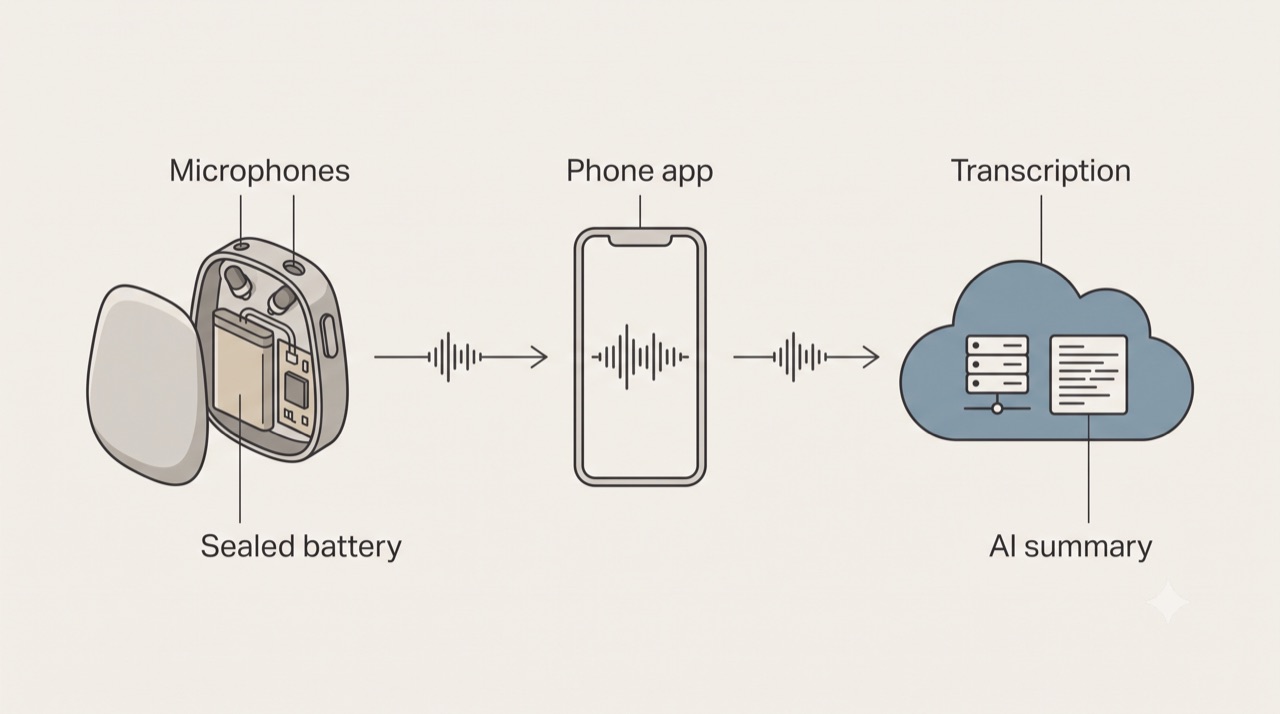
Before we break down what to look for, here's what's actually happening between you talking and a summary appearing — and why the little device on your collar is the least interesting part:
The subscription is the real price tag
This is the number the sticker price hides, and it's the most important decision you'll make.
The typical model works like a printer and ink. You buy the hardware — often somewhere around $150 to $180 — and it comes bundled with a free starter plan capped at a few hundred transcription minutes per month, commonly about 300 minutes, or roughly five hours. That sounds like plenty until you actually wear it: a couple of hour-long meetings and a lecture, and you've spent the month's allowance by Tuesday. To get meaningful volume you move to a paid tier, which in this category commonly lands around $100 a year for a larger monthly allotment and closer to $240 a year for effectively unlimited transcription.
So the true cost isn't the box. Run the multi-year math the way you would for any subscription hardware:
- Subscription recorder: sticker price + (annual fee × the years you'll use it). A "$159" device on a $99.99/year plan is really ~$460 over three years.
- Buy-outright or on-device recorder: sticker price, full stop.
Neither model is automatically wrong — subscription revenue often funds better AI models over time, while a one-time-purchase or on-device device wins on total cost of ownership. But you must know which one you're buying, and "starts at $159" tells you almost nothing until you know the plan.
"AI summaries" and "unlimited transcription" are the softest claims on the box
Brands lead with the magic: it summarizes your meetings, organizes your notes, gives you AI insights. In practice, the quality of that summary depends entirely on the underlying transcription and language model, and both stumble in exactly the conditions you'd use a recorder in — crosstalk, accents, background noise, and speakers who trail off. A confident-looking summary that quietly misattributes who said what, or invents an action item that was never agreed, is worse than no summary, because you'll trust it.
"Unlimited transcription" deserves the same skepticism. It's frequently the name of the most expensive tier, not a property of the device — and even where minutes are generous, the AI features that make the gadget worth wearing (speaker labels, summaries, search) are often the parts gated behind the top plan. Judge one of these by whether real long-term users find the transcripts accurate and the summaries trustworthy, not by the adjectives in the listing.
Where your audio actually goes — cloud versus on-device
Here's the part the friendly marketing avoids: on most of the best-known recorders, your audio doesn't stay on the device. It's uploaded to the company's cloud to be transcribed and summarized, which means your meetings, phone calls, and private conversations are stored on someone else's servers, governed by their privacy policy, retention schedule, and — read carefully — their rules about using data to train models.
This isn't hypothetical worry. The AI-notes space has already produced real complaints and litigation: tools that emailed transcripts and snippets to people who never attended the meeting, and claims that services extracted biometric voiceprints from recordings without consent. On-device transcription has improved fast and now closes much of the accuracy gap, so a recorder that can process audio locally is a genuine privacy advantage, not just a spec. If sensitive conversations are ever in scope, prioritize on-device processing, find out how long the company keeps your audio, and never assume "encrypted" means the vendor can't access or learn from your recordings.
The consent law is your responsibility, not the gadget's
An AI recorder's whole appeal is that it captures everything effortlessly — which is precisely what makes it easy to break a law you didn't know applied to you.
Recording rules depend on where the people talking are. Many U.S. states allow one-party consent, but roughly eleven are strict all-party-consent states — including California, Florida, Illinois, Massachusetts, Pennsylvania, and Washington — where recording a conversation without everyone's permission can be illegal. Illinois adds a biometric-privacy law that has been aimed at tools extracting voiceprints. The device will happily record a room full of people who never agreed to it and never tell you there's a problem. Before you rely on one for calls or meetings, learn the rule where you and the other participants are, and get consent — because when it goes wrong, the liability is yours, not the manufacturer's.
When you buy an AI voice recorder, you're committing to a subscription the sticker price hides, a minutes cap that runs out faster than it sounds, a cloud relationship with your most private conversations, and a legal duty the gadget quietly hands you. The launch-day demo, filmed with one clear speaker in a quiet room, can't tell you how the transcripts hold up in a noisy meeting, what the plan costs in year three, or how the company treats your data — but the people who've lived with one can.
Subscription costs, transcription caps, cloud privacy, and real-world transcript accuracy don't show up in product photos. Use Avorio to aggregate real long-term owner reviews, check Reddit sentiment, and find the best live price on the AI recorder that's actually cheapest — and safest — to own →
Don't rely on static reviews to make the final call. Avorio aggregates thousands of real user reviews, filters out sponsored and AI-generated content, scores subscription value, transcription accuracy, and privacy across Reddit, YouTube, and social media, and finds the lowest live price.
Search AI voice recorders on Avorio →
Frequently asked questions
Do AI voice recorders require a monthly subscription?
Most of the popular ones effectively do, and this is the single most important thing to check before buying. The hardware usually ships with a free starter tier that caps you at a few hundred transcription minutes per month — often around 300 minutes, roughly five hours — which sounds generous until you realize a single day of back-to-back meetings can burn through it. Beyond that cap you're pushed onto a paid plan that commonly runs somewhere around $100 to $240 a year for higher or unlimited minutes. So a device with a low sticker price can quietly become that price plus a recurring fee for as long as you use it. Neither model is automatically wrong, but you must know which one you're buying and do the multi-year math.
Are AI voice recorders private and secure?
It depends heavily on whether the transcription happens on the device or in the cloud, and most of the best-known models send your audio to a company server to be transcribed and summarized. That means your meetings, calls, and private conversations live on someone else's infrastructure under their privacy policy and retention rules. There have been real complaints and lawsuits in this space over transcripts being emailed to people who never attended a meeting and over voiceprints being extracted without consent. If privacy matters to you, prioritize a model that can transcribe on-device, read the retention policy before you buy, and never assume "encrypted" means the company can't read or train on your recordings.
Is it legal to record conversations with an AI voice recorder?
Sometimes it isn't, and the device won't warn you. Recording law varies by location: many U.S. states allow one-party consent, but roughly eleven are strict all-party consent states — including California, Florida, Illinois, Massachusetts, Pennsylvania, and Washington — where recording a conversation without everyone's permission can break the law. Illinois also has a biometric privacy law that has been used against tools that extract voiceprints. An AI recorder makes capturing everything effortless, which is exactly why it's easy to cross a line without realizing it. The responsibility to get consent is yours, not the device's, so learn the rule where you are before you press record.
Avorio cuts through sponsored content to surface authentic product reviews from Reddit, YouTube, and social media — and finds the best live prices. Search AI voice recorders on Avorio →