


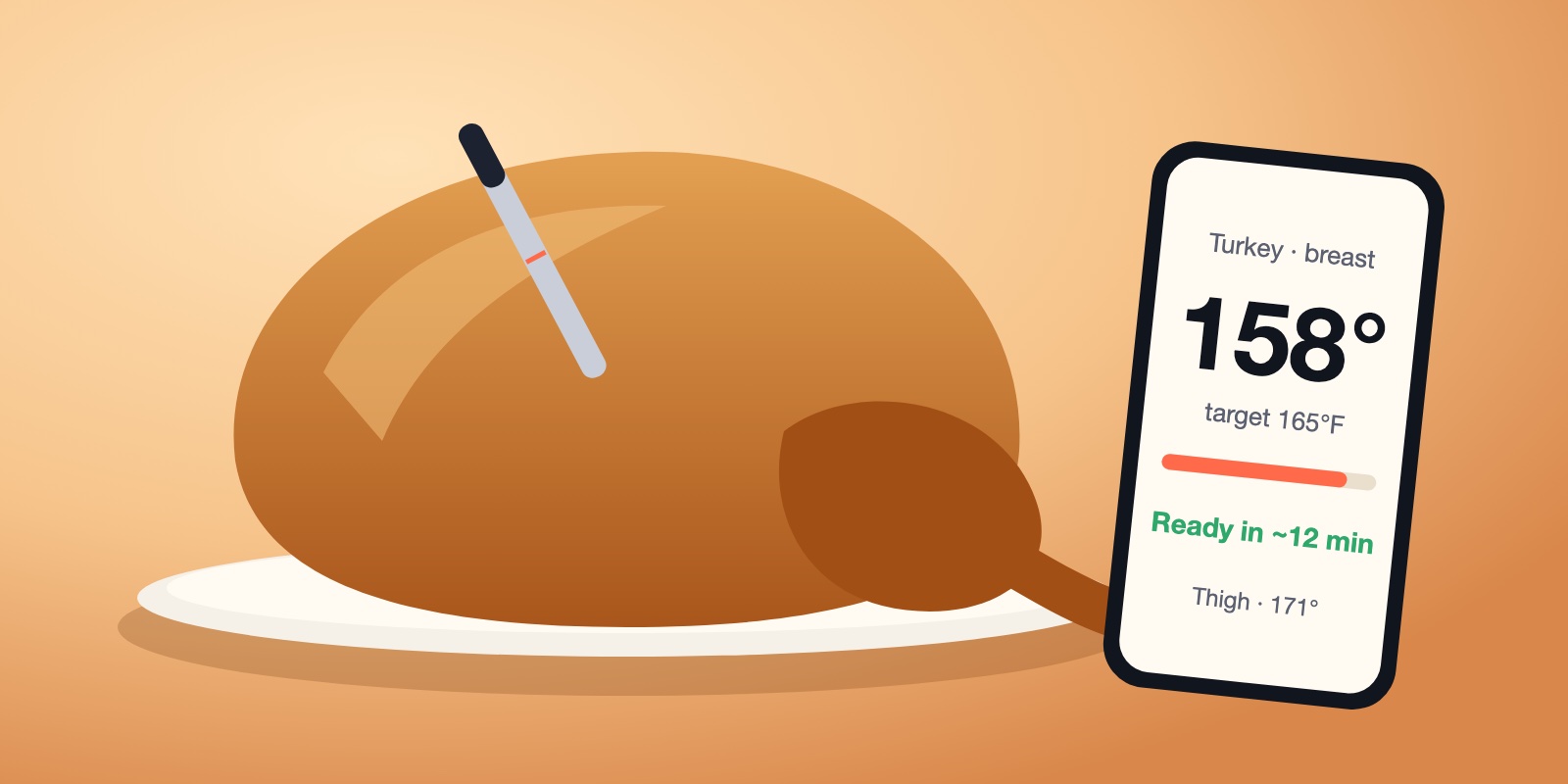
How to Choose a Wireless Meat Thermometer in 2026: Ignore the Range Claims, Check Probe Count, Placement, Accuracy, and the Black Friday Price
Thermometers go on sale the week before the turkey does.
Black Friday falls the day after Thanksgiving, so the sales that matter for this one start early. Buy before the bird goes in, not after.
Every November the same thing happens. Someone in your family buys a 16-pound turkey, cooks it for four hours, and then stands at the counter cutting into it to see whether it's done. The breast comes out dry, the thigh comes out pink, and everyone says it's great.
A wireless meat thermometer fixes most of that. You put a probe in the bird, close the oven, and your phone tells you the temperature until it's time to pull it out. They're also on sale right now. ThermoWorks has its RFX kits at 30% off, and Bluetooth probes from ThermoPro and Typhur sit between $36 and $50 on Amazon.
The listings compete on range in feet, how many sensors a probe has, and how hot it can go. Those numbers don't tell you much about Thanksgiving. What matters is how many probes you get, where you put them, whether the signal makes it out of your oven, and whether the reading is right.
The short answer
- Get two probes if you cook turkey, one for the breast and one for the thigh. With one probe, put it in the breast and check the thigh by hand.
- Ignore the range on the box. It's measured in open air, and your oven door cuts it a lot. Look for a base or booster that sits near the oven.
- Check the accuracy yourself in ice water as soon as it arrives. It should read 32°F.
- Look at the handle's heat limit if you smoke, grill or roast hot. The handle has the electronics in it and has to stay outside the meat.
- Check the price history. Thermometers carry "was" prices nearly all year.
Compare live prices and real owner reviews for wireless meat thermometers on Avorio →
Two kinds of wireless
"Wireless" covers two different designs, and the difference matters more than any spec.
Truly wireless probes, like Meater, Typhur Sync, ThermoPro's TempSpike and ThermoWorks RFX, are a single metal stick. The sensor is in the tip, and the battery and radio are in a handle that stays outside the meat. There's no cable to pinch in the oven door. The tradeoff is that everything has to fit in that stick, so range and battery are limited.
The older design is a wired probe plugged into a transmitter that sits outside the oven. The cable runs through the door seal. It's less elegant, but the radio sits in the open with a bigger battery, so range is rarely a problem, and the probes are cheap to replace.
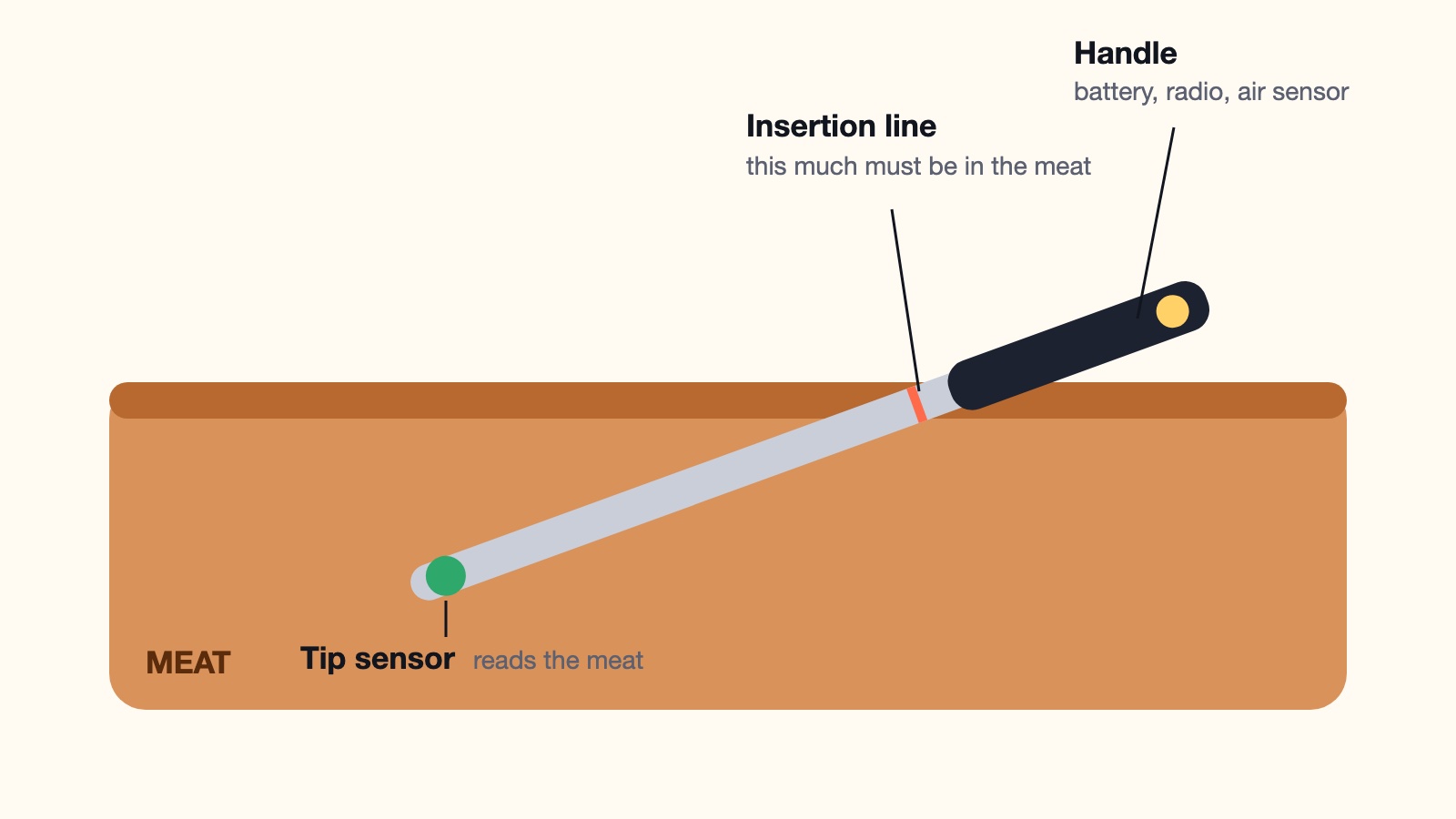
Every truly wireless probe has an insertion line printed on the shaft. Everything below it has to be in the meat, because the electronics above it can only take so much heat. The handle often has a second sensor that reads the oven air, which is how the app estimates how long is left.
Where the probes go
This is where most turkeys go wrong, and no thermometer fixes a probe in the wrong spot. The USDA says to check the thickest part of the breast, the innermost part of the thigh and the wing, all of it reaching 165°F. Try finding the right spots yourself:
Where does the probe go?
Tap a spot on the bird. Find the two places your probes belong.
Six spots, two right answers. Every wrong one teaches you something, so tap them all.
The breast and the thigh finish at different times. The breast is lean, sits on top and dries out first. The thigh is dark meat, sits lower in the pan and is usually last. That's why two probes are the useful number for a turkey: the breast tells you when to pull the bird, and the thigh tells you whether you can.
The bird also keeps warming after it comes out of the oven. Many cooks set the breast alarm a few degrees under 165°F and let the rest carry it up. If you do that, watch the number through the rest and make sure it actually gets there. A wireless probe is good for this, because you can leave it in while the bird sits on the counter.
Ignore the range on the box
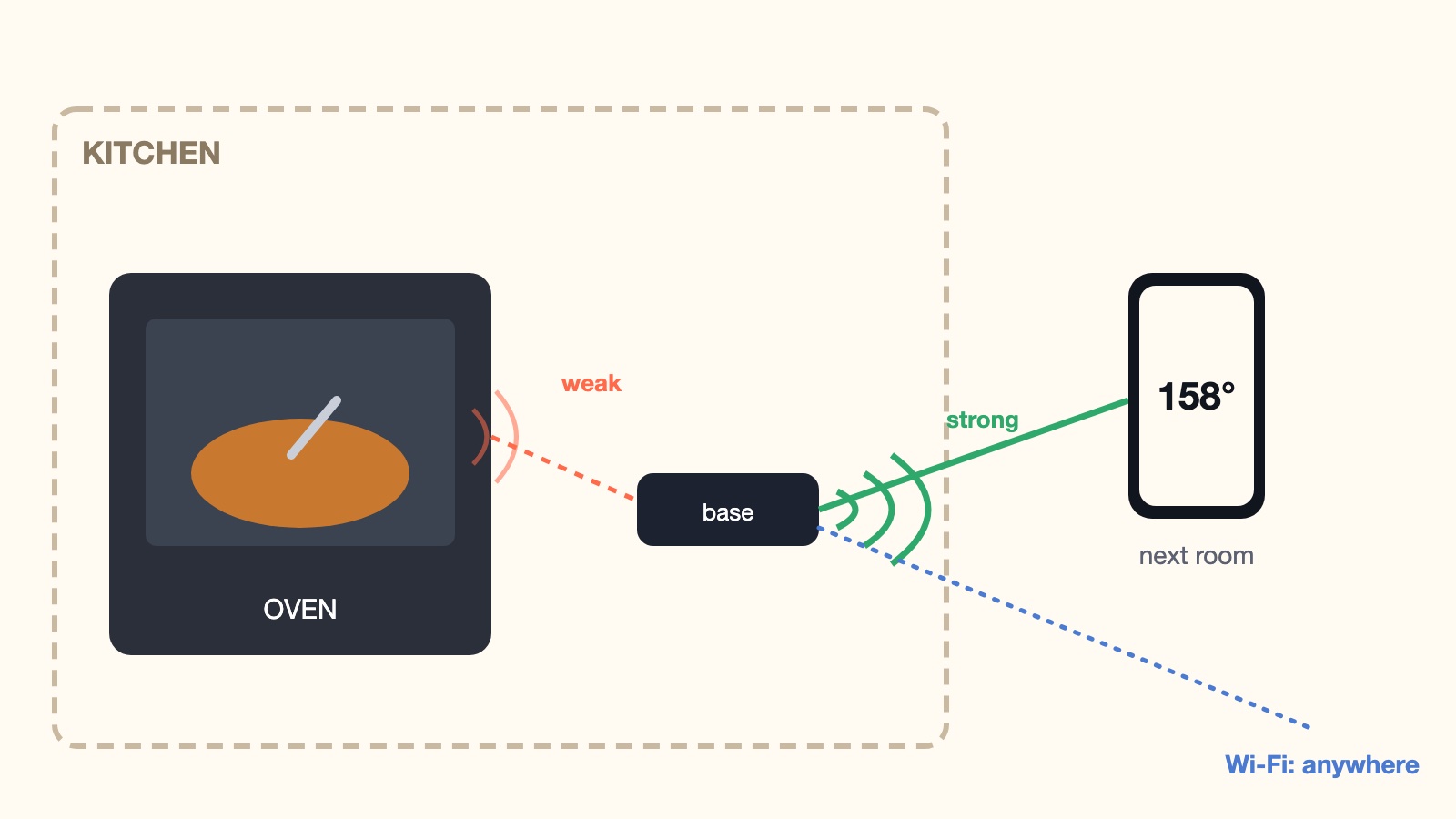
Listings promise 500, 600, even "unlimited" feet. Those numbers are measured in open air, in a straight line, with nothing in the way. Your oven is a metal box. The signal has to get out through the door glass, then through your kitchen walls to wherever you're sitting.
What makes a difference:
- A base or booster near the oven. Most models now include one that charges the probes and relays the signal. A probe that only talks directly to your phone is the one that drops out halfway through dinner.
- Wi-Fi in the base, if you want to check the bird from the store or the neighbor's house. Bluetooth alone keeps you near the kitchen.
- Probe orientation. Testers at NakedWhiz found the Bluetooth signal from some probes radiates most strongly out of the sides, so a probe sticking straight up out of the bird may hold its connection better.
- Some newer models advertise sub-1GHz radios (often written "Sub-1G"), which pass through walls better than Bluetooth. The range figures are still the maker's own.
If your kitchen opens onto the room where everyone eats, almost anything works. If you'll be in the basement watching football, pay for the base.
Sensors, accuracy, and the ice water test
Newer probes have several sensors along the shaft, and the app reports whichever is coolest. That helps when you don't hit the exact center, which with a turkey is often. It doesn't help if the probe is in the wrong place, and "6 sensors" on a listing doesn't tell you whether any of them is accurate.
Accuracy is easy to check, so check it the day the thermometer arrives, while you can still return it:
- Fill a glass with ice, add a little cold water, and stir for a minute.
- Put the probe in up to the insertion line without touching the glass.
- It should read 32°F within a degree or two.
You can also use boiling water. It's 212°F at sea level and about a degree lower for every 500 feet of altitude, so in Denver expect around 202°F. Reviewers who test thermometers in a lab find most probes land within about a degree of what they claim, and the ambient sensor in the handle is usually the less accurate of the two. Trust the tip reading over the oven estimate.
Heat, batteries, and the app
A few things owners run into after the first cook:
- The handle has a temperature limit. A rotisserie or a grill with the handle over a live flame can push it past what it's rated for, and heat is the usual way these probes get damaged. Check the rating if you smoke or grill your turkey, and check the manual before putting any probe near a deep fryer.
- Battery life varies a lot. A big turkey can roast for four hours or more, and a smoked one much longer. Look for the rated run time and how long a full charge takes, and charge it the night before.
- Most probes are hand-wash only. Look for a waterproof rating if you want to rinse it under the tap.
- The app is the screen. Read its recent reviews, and check whether it needs an account. An app that stops getting updates turns a $180 thermometer into a stick. On Amazon, Meater's $180 Pro Duo averaged 3.7 stars across about 1,300 ratings when we checked.
Read the Black Friday price carefully
Thermometer sales start well before Black Friday, which is lucky, because Black Friday is the day after you needed it. When we checked on November 12, ThermoWorks had its RFX kits at 30% off on its own site: $125.30 for one probe (was $179) and $272.30 for four (was $389). On Amazon, ThermoPro's TempSpike was $35.99 against a $49.99 list price, and Typhur's Sync Gold Gen2 was $49.99.
Before you buy, look at what it sold for over the last few months. A lot of cheaper listings show the same "was" price all year. And order early enough to run the ice water test before Thursday.
Deal or dud?
Things meat thermometer listings really say this time of year. Call each one before you peek.
600 FT WIRELESS RANGE!!
Two probes, plus a charging base that relays to your phone over Wi-Fi.
6 sensors! Smart AI cooking!
Accurate to ±1°F. Handle rated to 527°F.
Never needs calibration. Lifetime accuracy guaranteed!
★★★★★ "Shipped fast, super cute box!!" (posted the day it arrived)
The best way to know whether a thermometer is worth its sale price is from people who've cooked with it for a year. Day-one reviews can rate the box. People on their third Thanksgiving can tell you whether the probe still holds a charge and whether the app still connects.
Use Avorio to read long-term owner reviews, see what Reddit's grilling crowd thinks, and find the best live Black Friday price on a wireless thermometer before the turkey goes in →
Avorio gathers thousands of real user reviews from Reddit, YouTube, and social media and filters out sponsored and AI-generated content. It scores accuracy, range, and reliability, and finds the lowest live price.
Search wireless meat thermometers on Avorio →
Frequently asked questions
What temperature should a turkey be when it's done?
The USDA's safe minimum for turkey is 165°F, checked in the thickest part of the breast, the innermost part of the thigh and the wing. Stuffing cooked inside the bird has to reach 165°F too. The bird keeps warming for a while after it comes out of the oven, so many cooks set the breast alarm a few degrees early and let the rest carry it up. If you do that, check that it actually reaches 165°F before you carve.
How many probes do I need for a turkey?
Two is the useful number: one in the thickest part of the breast and one in the thigh, because the breast is the part that dries out and the thigh is the last to finish. With a single probe, put it in the breast and check the thigh with an instant-read thermometer before you pull the bird.
Do wireless meat thermometers work inside an oven?
Yes, but the oven cuts the range a lot. An oven is a metal box, and the signal has to get out through the door. Range figures on the box are measured in open air, so plan for much less. Most models solve this with a charging base or booster that sits near the oven and relays the signal to your phone, and some add Wi-Fi so you can check from anywhere.
How do I check if my meat thermometer is accurate?
Fill a glass with ice and a little water, stir, wait a minute, and put the probe in without touching the glass. It should read 32°F. Boiling water reads 212°F at sea level and about a degree less for every 500 feet of altitude. If it's off by more than a degree or two, check the app for a calibration setting or contact the maker.
Avorio filters out sponsored content to show real product reviews from Reddit, YouTube, and social media, and finds the best live prices. Search wireless meat thermometers on Avorio →