How to Choose a Mini Projector in 2026: Ignore the Lumens Number, Watch the Real Brightness and Streaming Trap
A mini projector is one of the most tempting gadgets going: a palm-sized box that promises a 120-inch movie night on any wall for the price of a mid-range monitor. The category has exploded, and the listings compete almost entirely on two numbers — a giant lumen figure and "4K" — that happen to be the two least trustworthy things on the page. It's easy to buy a projector rated at "12,000 lumens" and "4K" that turns out to be a dim 720p panel which can't even run Netflix without an add-on stick.
Here is exactly what matters when choosing a mini projector, and what is just marketing noise.
The short answer
If you want to skip the deep dive, here is the baseline of what to look for in a modern mini projector:
- Only ANSI/ISO lumens count: Check this first. Budget projectors quote "LED lumens" or peak numbers that inflate real brightness two to three times. Genuine mini projectors are mostly 120–350 ANSI lumens; ignore any figure without "ANSI" or "ISO" next to it.
- "4K" usually means native 1080p or 720p: Most pocket projectors only accept a 4K signal, then downscale it to a much lower native panel. Look up the native resolution, not the "supported" one.
- Streaming may not actually work: Many cheap models run unlicensed Android where Netflix and Disney+ won't install or are capped at low resolution. If you want native streaming, verify the specific apps, not just "smart TV built in."
- The LED dims, and it's sealed: LED light engines last tens of thousands of hours but fade over time and can't be replaced. Buy enough brightness to still be happy years in.
Compare live prices and aggregated Reddit sentiment scores for top mini projectors on Avorio →
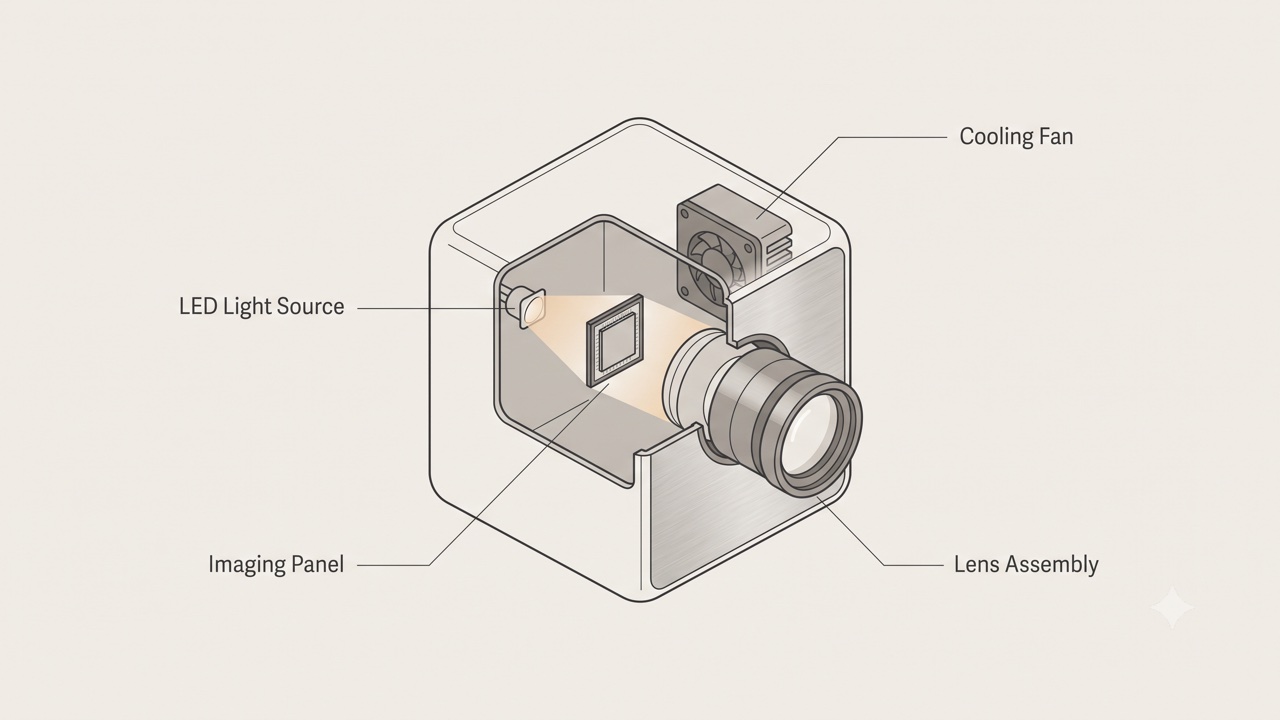
Before we break down what to look for, here's what's actually inside that little cube — and why the light engine and panel matter far more than the number on the box:
The lumen number is the biggest lie on the box
This is the spec every listing screams, and it's the one you should trust least.
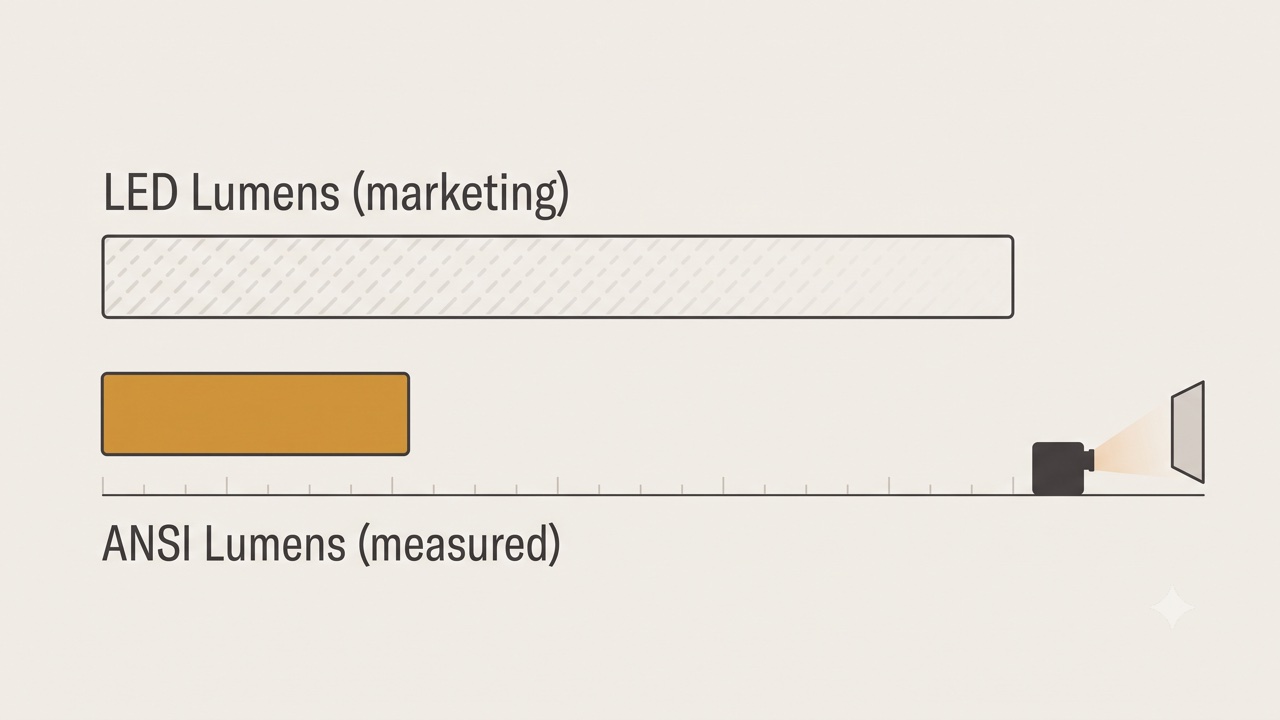
Brightness for projectors has a real, standardized unit: the ANSI lumen (and the newer, closely related ISO lumen), measured under lab conditions to describe usable light on the wall. The problem is that nothing forces a seller to use it, so budget brands invent friendlier-sounding figures — "LED lumens," "light source lumens," or just an unlabeled "lumens" — that routinely overstate real output by two to three times. A projector advertised as "9,000 lumens" for under a hundred dollars is almost never a genuine 9,000 ANSI; it's a marketing number with no standard behind it.
Here's the reality check: most genuine mini projectors deliver somewhere between roughly 120 and 350 ANSI lumens. That's enough for a good picture in a properly dark room and completely washed out in daylight. Anything claiming thousands of "lumens" at a pocket price is using the inflated measurement. When you see a number without "ANSI" or "ISO" next to it, mentally divide by two or three — or better, ignore it and hunt down the real figure in reviews.
"4K support" almost never means a 4K picture
The second headline number plays the same trick. A listing that says "4K" in big type, then "supported" or "compatible" in small type, is telling you the projector can accept a 4K signal and squeeze it down onto a much lower-resolution panel. The native resolution — the actual number of pixels the imaging chip can display — is what you'll see, and on mini projectors it's usually 1080p at best and frequently 720p.
That downscaled image isn't worthless, but it is not 4K, and paying a premium for "4K" on a pocket projector generally buys you nothing. The number that matters is native resolution, stated plainly. If a product page hides it, buries it, or only ever says "supports 4K," assume the native panel is low and price it accordingly.
The streaming trap: it may not run Netflix at all
This is the trap that shows up on movie night, after you've already bought it. Loads of mini projectors advertise a built-in "smart" system with apps — the photos show Netflix, YouTube, Disney+ tiles right on the home screen. What the listing often doesn't say is that many budget models run an unlicensed or uncertified Android build, and on those, the big streaming apps either refuse to install, silently drop to low resolution, or only work through a clumsy web workaround.
The common fix is to ignore the built-in system entirely and plug in a separate streaming stick — which works, but means the "smart" projector you paid extra for is really just a screen with an HDMI port, plus another dongle and remote to manage. If native streaming is part of why you're buying, confirm the projector is officially licensed for the specific services you use (real app-store certification, not just "apps included"). And if you're happy to run everything off an external stick anyway, don't pay a cent extra for the built-in OS.
Real brightness beats spec-sheet brightness, and the LED fades
The honest way to shop this category is to forget the box entirely and anchor on real ANSI brightness matched to your room. In a fully dark room, a few hundred ANSI lumens looks great. Add any ambient light — a lamp, a gap in the curtains, dusk through a window — and you need far more real brightness than most minis have, which is why the "backyard movie night in daylight" fantasy rarely survives contact with an actual mini projector.
There's a slow-burn factor too. An LED light engine is rated for tens of thousands of hours, so unlike the old lamp projectors it won't suddenly die — but LEDs dim gradually over their life, and the engine is sealed with no user replacement. A projector that's only just bright enough in a dark room today will be visibly dimmer a few years in. Buy enough headroom that you're still happy after the LED fades, not a model that's marginal when brand new.
When you buy a mini projector, you're committing to a native panel the "4K" label hides, a real brightness the lumen number obscures, and maybe a streaming system that won't run your apps. The launch-day unboxing video, filmed in a pitch-black room with fresh hardware, can't tell you how it holds up in your living room two years in — but the people who've owned one that long can.
Real ANSI brightness, true native resolution, and whether streaming actually works don't show up in product photos. Use Avorio to aggregate real long-term owner reviews, check Reddit sentiment, and find the best live price on the projector that's actually worth owning →
Don't rely on static reviews to make the final call. Avorio aggregates thousands of real user reviews, filters out sponsored and AI-generated content, scores real-world brightness, resolution, and streaming reliability across Reddit, YouTube, and social media, and finds the lowest live price.
Search mini projectors on Avorio →
Frequently asked questions
What do the lumens on a mini projector actually mean?
Often very little, because most cheap projectors quote "LED lumens" or peak numbers instead of ANSI lumens. ANSI (or the newer ISO) lumens are a standardized, lab-measured figure for usable brightness; "LED lumens" and unlabeled "lumens" are marketing figures that routinely inflate the real number two to three times over. Most genuine mini projectors land between roughly 120 and 350 ANSI lumens, so a listing shouting "9,000 lumens" at a budget price is telling you it isn't using the honest measurement. Always look for an ANSI or ISO number, and treat everything else as unverified.
Can a mini projector really play Netflix in 4K?
Usually not the way the box implies. Many pocket projectors advertise "4K support," which only means they can accept and downscale a 4K signal — the actual panel is almost always 1080p or even 720p native. Separately, a lot of budget models run an unlicensed Android build where Netflix, Disney+, and other apps either won't install or only run at low resolution, forcing you to plug in an external streaming stick. If native streaming matters, check that the projector is licensed for the specific apps you use, not just that it "has apps."
How long does the LED in a mini projector last?
The LED light source itself is usually rated for tens of thousands of hours, far longer than an old lamp projector, so it rarely "burns out." The catch is that LEDs dim gradually over their life, so a projector that looks bright in a dark room on day one is measurably dimmer years in — and because the light engine is sealed, there's no user replacement. Buy enough real ANSI brightness that you're comfortable even after the LED fades, rather than a model that's only barely bright enough when brand new.
Avorio cuts through sponsored content to surface authentic product reviews from Reddit, YouTube, and social media — and finds the best live prices. Search mini projectors on Avorio →