

How to Choose a High-Speed Hair Dryer in 2026: Ignore the RPM, Check Airflow, Heat, Weight, and Safety
High-speed hair dryers now come at almost every price, from about $25 listings on marketplaces to $499.99 for the Dyson Supersonic Nural at launch, with brands like Laifen around $130 to $170. Exploding Topics puts search growth for "high speed hair dryer" at about 9,200% over five years.
Almost all of them lead with the same two numbers: motor RPM and ion count. Neither one tells you how fast your hair will dry or how hot the air will be. At the cheap end there's a bigger issue, because some of these dryers have turned up in federal safety warnings.
The short answer
If you just want the checklist:
- Treat RPM as a starting point at most. Airflow and nozzle design decide how well the motor's speed reaches your hair.
- Look for a heat setting you'll actually use. Speed only protects your hair if it lets you turn the temperature down.
- Check the weight with the attachment on, especially if you have long or thick hair and hold the dryer for a while.
- Make sure the filter comes off for cleaning. Lint and hair build up there.
- On a cheap dryer, confirm it has immersion protection and a safety lab listing, then search the model on the CPSC site.
Compare live prices and real owner reviews for top hair dryers on Avorio →
What "high-speed" means, and why RPM isn't enough
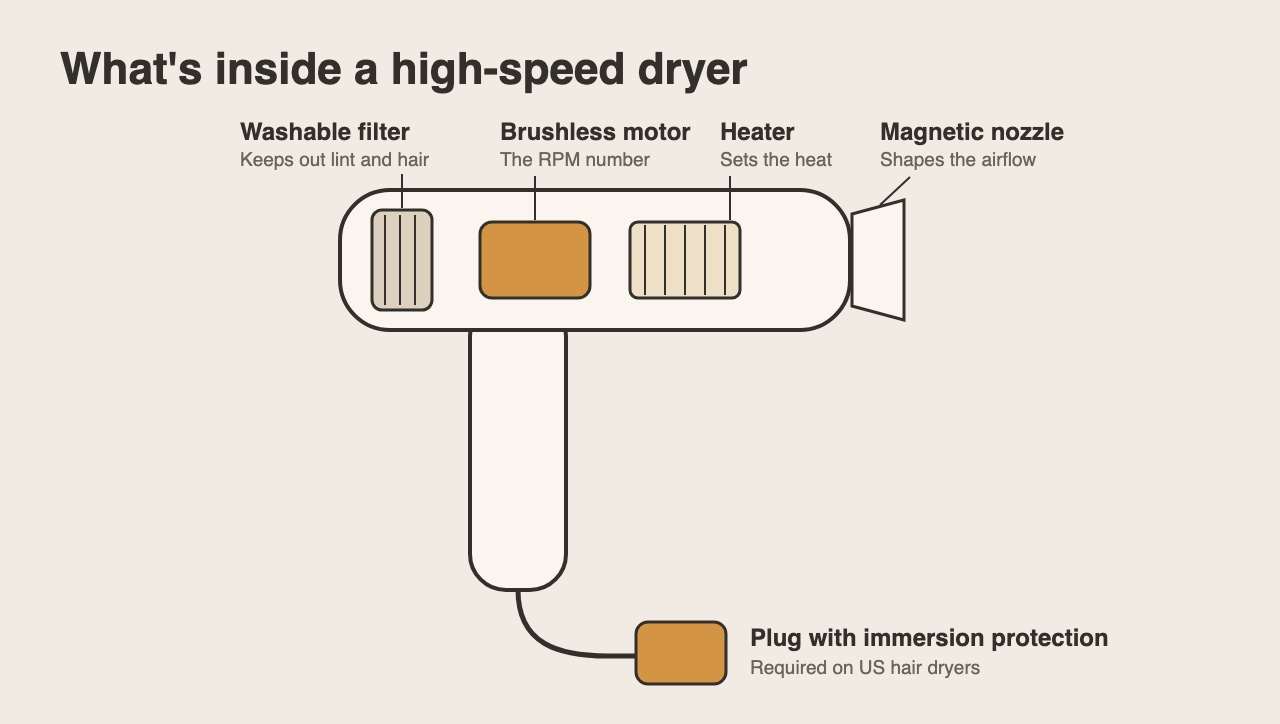
A high-speed dryer uses a small brushless motor, usually rated somewhere above 100,000 RPM. Laifen's SE, for example, is rated at 105,000 RPM and its Swift Special at 110,000. The small motor is why these dryers can be light, and why many of them put the weight in the handle.
The RPM figure only describes the motor. To dry your hair, that spinning has to become moving air, which depends on the fan and the nozzle. Two dryers with the same motor speed can perform differently, and a listing can print any number it likes. Some cheap models now advertise 150,000 RPM or more, and that number means little without an independent test behind it.
Airflow numbers are worth reading carefully
Airflow is a better number to compare, but the specs are messy. Brands and retailers quote it in two different units:
- Meters per second (m/s) is how fast the air is moving. It's useful for smoothing and for getting air to the roots.
- Liters per second (L/s) is how much air the dryer moves. It matters more for getting a lot of hair dry.
These aren't interchangeable, and retailers do mix them up. We found the same Laifen line listed at about 21 m/s in one place and around 21 L/s in another. If two dryers quote different units, you can't compare them directly, so fall back on reviews.
Wattage still counts too, since it affects how much heat the dryer can add. When Hong Kong's Consumer Council tested 13 dryers, models rated 1,700W or more generally dried faster, and the fastest removed almost twice as much water per minute as the slowest (6.3 g versus 3.4 g). That test didn't focus on high-speed models, so it can't settle the question of motor versus wattage. Laifen's SE 2, for comparison, is listed at 1,400 to 1,500W, so a high-wattage conventional dryer may still keep up. Price didn't reliably predict the score either: models from just over HK$100 to over HK$3,000 earned the same overall rating.
Heat matters more than speed for your hair
The reason to want more airflow is that it can let you dry at a lower temperature. Whether you get that benefit depends on the dryer and on how you use it.
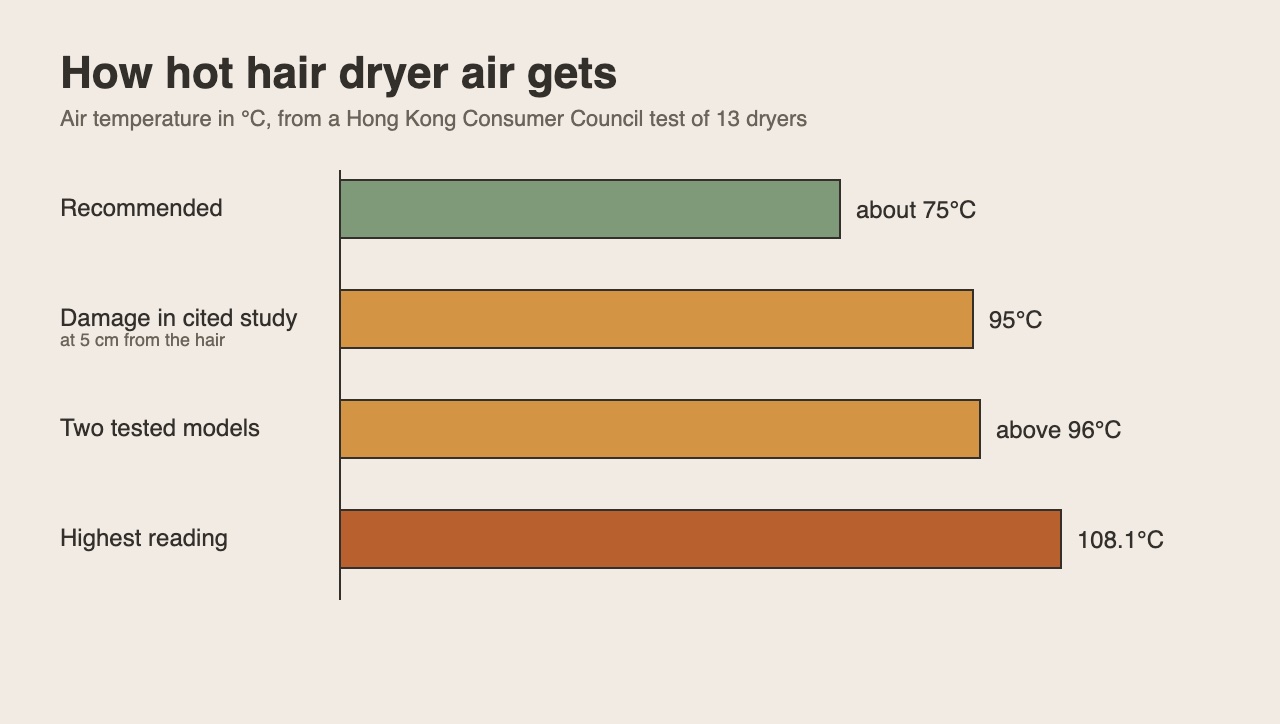
The Consumer Council recommends drying at about 75°C (167°F). Two dryers in its test went above 96°C at certain distances, and one reached 108.1°C (about 227°F). A study it cites found that 95°C at 5 cm damaged the cuticle.
Distance and motion help a lot. A 2011 study in the Annals of Dermatology found that hair surfaces took more damage as temperature rose, but that a dryer held 15 cm away and kept moving did less damage than air drying alone.
Don't assume "high-speed" means cooler, either. TechRadar found the GHD Speed clearly hotter than the Dyson Supersonic Nural on their top settings, and both are high-speed dryers. Look for separate heat and speed controls, a usable low-heat setting, and reviews that mention scalp comfort. Dyson's Scalp Protect mode and similar sensor features aim at this problem, and they may be worth paying for if you use a lot of heat.
Ion counts are mostly marketing
Nearly every high-speed dryer advertises negative ions, sometimes in the hundreds of millions. The Consumer Council's measurements ranged from 361 to about 89.9 million ions per cubic centimeter. One model measured about the same as a control dryer with no ion feature. Another claimed 100 million and measured about 16 million.
Its conclusion was modest: ions may temporarily help with frizz, but they don't repair the hair's surface. It's fine to enjoy the effect if you notice one. Just don't pay extra for a bigger number.
Check for immersion protection on cheap dryers
This is the part most gift guides skip. US rules require hair dryers to have immersion protection, which reduces the risk of electrocution if a plugged-in dryer falls in water. In the US it often lives in the large plug with test and reset buttons. The CPSC has issued a run of recalls and warnings over dryers without it:
- An August 2026 warning told people to stop using DEISNGB dryer brushes, sold on Walmart.com and TikTok Shop for $18 to $28, and to cut the cord before throwing them out.
- The DHASUWT brush recall added 10 reports of smoking or fire.
- In August 2025, about 56,300 Remington-brand D3190DCDN dryers sold online for $25 to $32 were recalled for the same missing protection, though no injuries were reported.
Those examples aren't all high-speed dryers, but they come from the same online marketplaces where most cheap high-speed models are sold. Before you buy, look for a listing from a recognized lab such as UL or ETL, make sure the seller is a company you can reach, and search the model number at cpsc.gov/Recalls. Also buy the version made for your country's power. A UK listing for the Laifen SE 2 Special is rated for 230V, which isn't what a US outlet supplies.
Weight, noise, and everything you'll notice daily
Weight is where this category really does improve on older dryers, though the differences within it are still noticeable. TechRadar put the Dyson Nural at around 455 g and the GHD Speed at around 620 g for the dryer alone. Laifen's SE 2 is listed at about 390 to 407 g, depending on the source. If you dry long or thick hair, 200 g makes a real difference by the end.
A few other things to check:
- Be skeptical of quoted decibel figures. Sellers rarely say how far away they measured, so the numbers don't compare well across brands. A decibel figure also won't tell you about pitch, and a quiet dryer can still have an annoying whine. Owner reviews are your best source here.
- A dryer should have a filter you can remove and wash, because that's what keeps lint and hair out of the motor. Check how easy it is to get to, since you'll be doing it regularly.
- Check which nozzles come in the box. If you have curly hair, make sure a diffuser is included and fits securely, and check how gentle the lowest speed is. One Best Buy reviewer said even the Dyson's lowest setting still blew a lot of air.
- Tom's Guide liked the Nural's sensor modes but found the buttons needed firm pressure. Button placement is worth checking in owner reviews, too.
- One retailer lists the Laifen SE 2 Special at 1,000 hours. At 15 minutes a day that's about 11 years, but it's a rated figure, not a test result. Long-term owner reviews will tell you more than the rating does.
Decide what you're paying for
You don't need the most expensive dryer to get most of the benefit. In the middle of the range, around $100 to $200, you typically get the light body and strong airflow. At the top, you're mainly paying for sensor-driven heat control, attachments, finish, and a brand with established service. Those can be worth it if you dry your hair every day and want the scalp protection, but most people should compare the mid-range first.
Below that, the choice gets harder. A $30 dryer with a big RPM number might work fine, or it might be one of the models the CPSC is warning about, and the listing won't always tell you which. At that price, a traditional dryer sold directly by a major retailer is often the safer buy.
A spec sheet can't tell you whether a dryer's lowest setting flattens your curls, or whether it still runs well after a year of lint. People who have owned one for a while can.
Use Avorio to read long-term owner reviews, see what Reddit thinks, and find the best live price on the hair dryer that fits your hair →
Avorio gathers real user reviews from Reddit, YouTube, and social media and filters out sponsored and AI-generated content. It scores drying speed, reliability, and comfort, and finds the lowest live price.
Search hair dryers on Avorio →
Frequently asked questions
Is a higher RPM hair dryer better?
Not on its own. RPM tells you how fast the motor spins, and a dryer can spin fast and still push air poorly if the fan and nozzle are badly designed. Compare airflow if the brand publishes it, then look for reviews from people with hair like yours. A 150,000 RPM claim on a cheap listing tells you very little.
Do negative ions in a hair dryer do anything?
They may calm frizz for a while, but they don't repair hair. When Hong Kong's Consumer Council tested 13 dryers, ion output ranged from 361 to about 89.9 million ions per cubic centimeter. One dryer measured about the same as a model with no ion feature, and another that claimed 100 million measured about 16 million. Treat an ion count as a marketing number.
Are cheap high-speed hair dryers safe?
Some are fine, but check before you buy. US rules require hair dryers to have immersion protection, and the CPSC keeps issuing recalls and stop-use warnings for cheap dryers and dryer brushes without it, including ones sold on Amazon, Walmart, and TikTok Shop. Look for a listing from a recognized safety lab such as UL or ETL, buy from a brand you can contact, and search the model number on cpsc.gov.
Does a high-speed dryer damage hair less?
It can, if you use its speed to dry at a lower heat setting, but the motor alone doesn't guarantee it. Heat varies between high-speed models too. Research links damage to temperature and distance: one study found that a dryer held 15 cm away and kept moving did less damage than air drying, while hair surfaces got worse as temperature went up.
Avorio filters out sponsored content to show real product reviews from Reddit, YouTube, and social media, and finds the best live prices. Search hair dryers on Avorio →