

How to Choose Noise-Cancelling Earbuds in 2026: Ignore the ANC Marketing, Check the Fit and the Battery
Noise-cancelling earbuds used to be a luxury you bought once. Now every brand ships a pair, the prices run from $40 to $300, and the spec sheets are an arms race of "Adaptive ANC 4.0," dedicated "AI audio" chips, and decibel-reduction figures nobody can verify. The trouble is that the numbers shouting at you from the box have almost nothing to do with whether you'll still be reaching for these buds in two years — or whether they'll be a dead, ill-fitting pair at the bottom of a drawer.
Here is exactly what matters when choosing noise-cancelling earbuds, and what is just marketing noise.
The short answer
If you want to skip the deep dive, here is the baseline of what to look for:
- Fit first, always. ANC physically cannot work if the ear tip doesn't seal. The right tip size matters more than the rating on the box. If a pair won't seal in your ear, no spec will save it.
- Real-world ANC, not the headline number. "Up to 50dB reduction" is a lab figure. What matters is how the buds handle the noise you face — a plane cabin, an open office, traffic — which only long-term user reviews reveal.
- Battery & the case you can't replace. ANC drains batteries fast. Expect 5–8 hours a charge, but know the sealed cells in the buds and case degrade — treat earbuds as a 2–3 year device, not forever.
- Ecosystem lock-in. Some features — best codecs, hands-free assistant, seamless switching — only work fully on one brand of phone. Buy for the phone you actually own.
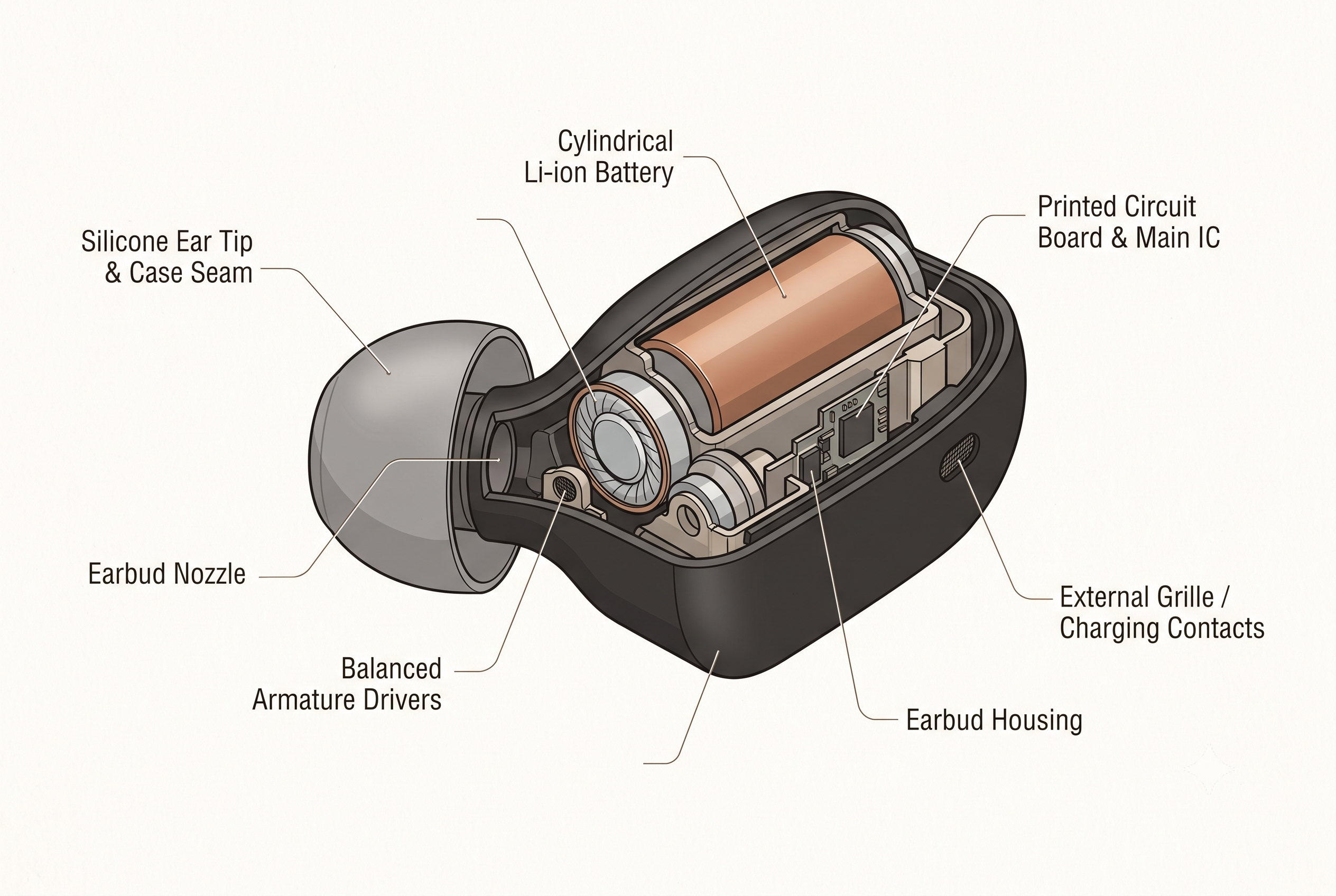
Before we break down what to look for, here's what's actually inside a bud the size of a bean — and why the noise-cancelling chip is the easy part:
Fit is the spec that decides everything
This is the thing the box won't lead with, and it's the most important decision you'll make.
Active noise cancellation works in two stages: a physical seal blocks high-frequency noise, and microphones plus a processor cancel the low-frequency rumble. If the seal fails, the whole system fails. A loose ear tip leaks bass, collapses the ANC, and makes even a $300 pair sound thin and cancel poorly. No amount of "AI" in the chip can fix a bud that doesn't seal your ear canal.
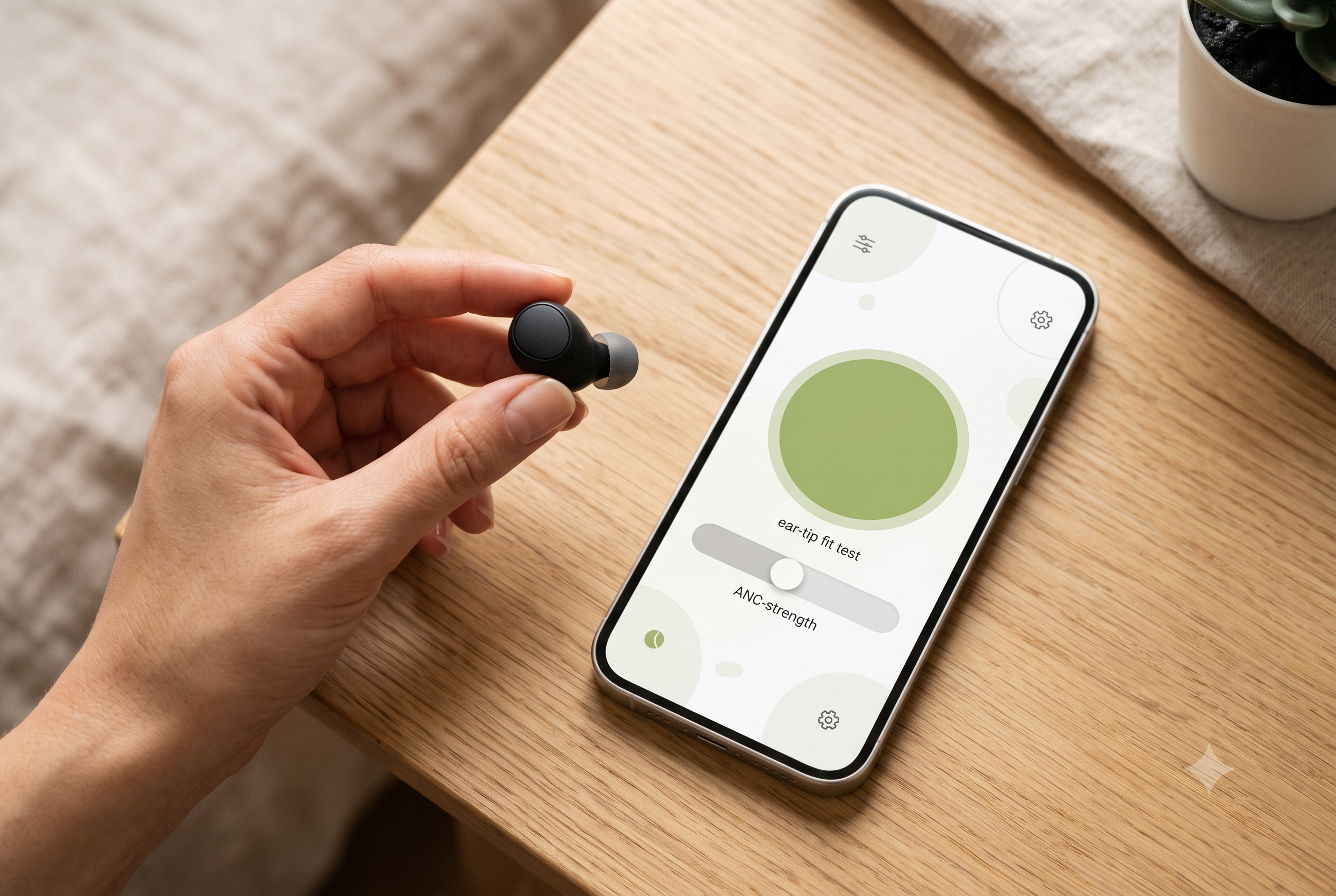
Every reputable pair ships with multiple sizes of silicone or foam tips — and the size that fits your left ear may not fit your right. The single highest-impact thing you can do is try every tip size, including the ones you assume are too big, and judge the seal by whether the bass suddenly fills in. Foam tips often seal better than silicone for awkward ear canals, at the cost of being a consumable you replace.
The practical takeaway: a $90 pair that seals perfectly in your ears will out-cancel a $250 pair that doesn't. Fit is not a tie-breaker. It is the whole game.
"ANC strength" numbers and "AI audio" are mostly marketing
Brands love to advertise a decibel figure — "up to 45dB of cancellation" — or a dedicated "AI audio chip" powering "Adaptive ANC." In practice, the headline number is measured in a lab under ideal conditions you'll never replicate, and the "AI" branding usually describes adaptive ANC that simply adjusts strength to ambient noise, which most mid-range buds now do.
What actually separates great ANC from a gimmick is how it handles the specific noise you live with. Some buds crush the low drone of a plane cabin but do nothing for nearby voices in an office. Others handle traffic well but hiss in quiet rooms. The decibel figure on the box tells you none of this. Long-term owner reviews from people in your situation — commuters, open-plan workers, frequent flyers — tell you everything.
"AI audio" is the reddest flag of all. Often it's a feature name wrapped around standard adaptive noise cancellation and EQ. Judge a pair by whether real users find the noise-cancelling genuinely effective for their environment, not by the chip's marketing name.
Battery life, and the batteries you can't replace
Active noise cancellation is power-hungry, so ANC earbuds typically last five to eight hours per charge, with the case topping them up for a total of 24 to 48 hours. That per-charge number is fine for most people — you drop them in the case between uses.
The real issue, exactly as with any small lithium device, is degradation. Earbuds contain three tiny sealed batteries — one in each bud and one in the case — and none of them can be replaced. They lose capacity faster than a phone because they're charged and discharged constantly, in a hot pocket, in a small cell. Many owners report that by 18 to 24 months their once-all-day buds barely last a commute, and a worn case battery means the buds never fully charge.
This makes earbuds a consumable, not a lifetime purchase. A $200 pair you replace every 2.5 years costs about $7 a month in hardware alone. Check a brand's reputation for battery life two years in — not the pristine launch-day spec — and weigh that against the sticker price.
Ecosystem lock-in: buy for the phone you own
Here's the trap that catches people who shop on specs alone: some of the best features only work on one brand of phone. Seamless device switching, the highest-quality audio codecs, hands-free voice assistant, and instant pairing are frequently tied to a specific ecosystem. Pair those same premium buds with a different phone and you may lose the codec, the auto-switching, and half the app features — leaving you with an expensive pair running in basic mode.
The fix is simple: decide based on the phone in your pocket. The "best" earbuds in a roundup may be the worst choice for your setup if their standout features are locked to hardware you don't own.
When you buy noise-cancelling earbuds, you're committing to a pair you'll wear for hours a day, on a battery that fades, with features that may depend on your phone. The launch-day review can't tell you whether the ANC held up on a real flight, whether the battery faded, or whether the fit drove someone crazy after a month — but the people six months and two years into ownership can.
ANC effectiveness, battery fade, fit complaints, and ecosystem lock-in don't show up in product photos. Use Avorio to aggregate real long-term owner reviews, check Reddit sentiment, and find the best live price on the earbuds that are actually cheapest to own →
Don't rely on static reviews to make the final call. Avorio aggregates thousands of real user reviews, filters out sponsored and AI-generated content, scores long-term battery life, real-world ANC, and fit across Reddit, YouTube, and social media, and finds the lowest live price.
Search noise-cancelling earbuds on Avorio →
Frequently asked questions
Do more expensive earbuds always cancel noise better?
No. Above roughly the mid-range, ANC performance depends far more on the ear-tip seal and how the buds are tuned for your specific noise environment than on price. A well-fitting $90 pair routinely out-cancels a poorly-fitting $250 pair, because a broken seal collapses noise cancellation no matter what the box claims.
How long do noise-cancelling earbuds last before the battery wears out?
Most pairs deliver five to eight hours of ANC playback per charge when new, with the case adding 24–48 hours. The number that matters more is degradation: the sealed batteries in the buds and case lose capacity over 18–24 months and can't be replaced, which effectively makes earbuds a consumable. Check a brand's battery track record two years in, not just the launch-day spec.
Does it matter which phone I use with wireless earbuds?
Yes, more than most buyers expect. Features like the highest-quality audio codecs, seamless device switching, hands-free assistant, and instant pairing are often tied to one phone ecosystem. The same premium buds can lose those features on a different brand of phone, so buy for the device you actually own.
Avorio cuts through sponsored content to surface authentic product reviews from Reddit, YouTube, and social media — and finds the best live prices. Search noise-cancelling earbuds on Avorio →